
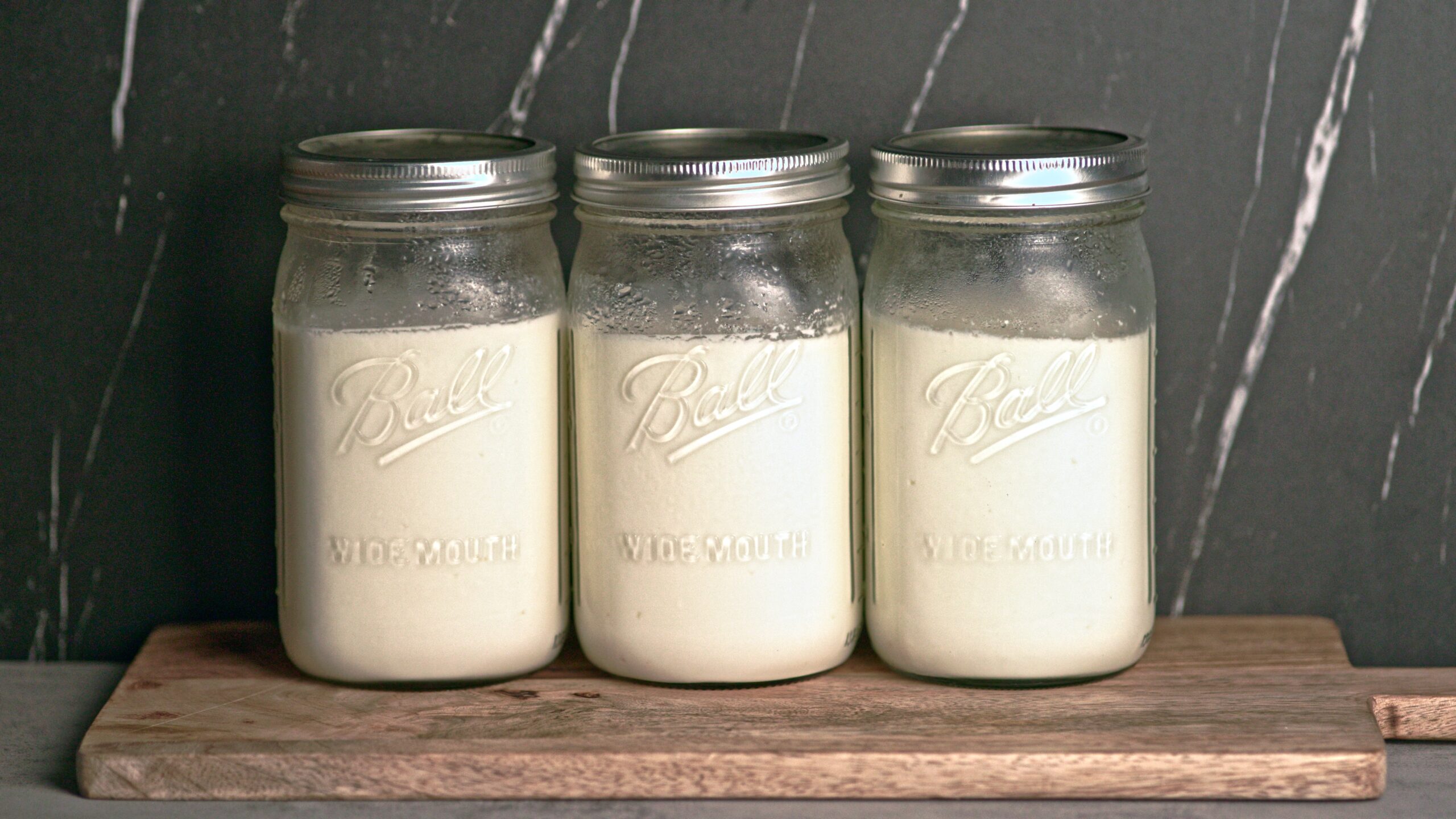
Servings: 6
Ingredients
*Recipe adapted from Dr. William Davis’ SIBO yogurt recipe
Original
- 10 BioGaia Gastrus tablets (L.reuteri ATTC PTA 6475 & DSM 17938) (total 2 billion CFUs)
- 2 Lactobacillus gasseri BNR-17 capsules (total 20 billion CFUs)
- 2 Bacillus coagulans GBI-30,6086 capsules (total 4 billion CFUs)
- 2 Tbsp prebiotic fiber (inulin or raw potato starch)
- 1 quart ultra-pasteurized half-and-half
*Updated recipe now uses the following instead of bacillus coagulans (although you can still use bacillus coagulans if you prefer)
- 2 Bacillus subtilis HU58 capsules (total 20 billion CFUs)
Larger Quantity (Subsequent Batches)
- 4 Tbsp prebiotic fiber (inulin or raw potato starch)
- 1/4 cup yogurt from a prior batch
- 1/2 gallon ultra-pasteurized whole milk
Instructions
Original
- Crush the BioGaia Gastrus tablets in a pill crusher. If you don’t have one, fold a towel over them and crush them using a meat tenderizer or hammer.
- In a medium-sized bowl, combine the crushed BioGaia Gastrus tablets, the contents of the probiotic capsules, the prebiotic fiber, and two tablespoons of organic half-and-half.
- Whisk vigorously to make a slurry to ensure the prebiotic fiber does not clump. This may take 5-10 minutes.
- Stir in the remaining half-and-half.
- Place in your fermenting device and ferment at 106°F/41°C for 36 hours.
- To make future batches, use two tablespoons of yogurt from a prior batch, two tablespoons of prebiotic fiber, and one quart of half-and-half. You do not need to use the tablets and capsules for future batches unless you have a faulty batch and want to restart fresh.
Larger Quantity
- After making the first batch of SIBO yogurt, you can adjust the recipe to make a larger quantity per batch. Use a half gallon of organic ultra-pasteurized whole milk (rather than a quart of half-and-half).
- Start by making a slurry with 4 Tbsp of inulin and a portion of the milk. Whisk vigorously until dissolved. This may take 5-10 minutes.
- Add the rest of the milk and 1/4 cup of yogurt from a prior batch and mix until well combined.
- Ferment for 36 hours at 106°F/41°C.
Video
Notes
-The first batch of yogurt will likely have significant yogurt and whey separation and taste acidic. Do not restart from scratch if you think you made a mistake, as you will likely experience the same outcome. Instead, use a portion of yogurt from the current batch to start your next batch. Subsequent batches will have little to no whey separation and taste pleasantly sour, not acidic.
-It’s best practice to sterilize your jars/yogurt-making equipment.
-This is technically not “yogurt,” as it’s made from different strains of Lactobacillus. Do not attempt to ferment at the higher temperatures of traditional yogurt, as you will kill your bacterial strains.
-I use my Instant Pot to make yogurt. However, the temperature it maintains is too high for SIBO yogurt. My workaround is to make the yogurt in glass jars rather than directly in the pot basin. This keeps the yogurt a few degrees cooler at the desired temperature.
*As an Amazon Associate, I earn from qualifying purchases. Thanks for your support!
Nutrition
Calories: 207kcal | Carbohydrates: 7g | Protein: 5g | Fat: 18g | Saturated Fat: 11g | Polyunsaturated Fat: 1g | Monounsaturated Fat: 5g | Cholesterol: 55mg | Sodium: 96mg | Potassium: 208mg | Sugar: 7g | Vitamin A: 558IU | Vitamin C: 1mg | Calcium: 169mg | Iron: 0.1mg
Nutrition values are approximate and may vary.
Have you tried this recipe?Comment below and tell us about it on Instagram! @wholeshenanigans
20 Responses
Can I substitute dairy for a plant based milk?
It’s more complex than substituting plant-based milk, as you need the lactose to feed the bacteria. Dr. Davis has a coconut milk recipe you can find via this link, however (I’ll have a video on this coming out soon!): https://innercircle.drdavisinfinitehealth.com/probiotic_yogurt_recipes
There are a bajillion YouTube videos and online recipes for SIBO Super Gut “yogurt.” This one is the most concise and easy to follow. I’m gifting some starter this week and have already printed out Whole Shenanigans’ recipe to send with it. After a couple of batches you quickly realize… this is easy. But this recipe (and the YT video) are the perfect amount of hand-holding to get you started and build confidence.
Thanks for your kind comments! It really is easy once you get the hang of it. So glad you’re making it, and thanks for taking the time to leave a comment. Best!
I have a question
On Dr. Davises video He only shows using 1 of his probiotic capsule. Why are you using so many different varieties?
Am I missing something on his video?
Dr. Davis has various yogurt recipes. For example, L. reuteri yogurt only uses L. reuteri probiotics, while SIBO yogurt uses L. reuteri, L. gasseri, and B. coagulans probiotics. You may also be referring to the fact that he came out with his own L. reuteri capsules recently (so you no longer have to use 10 BioGaia tablets if you instead buy his brand). Hope that helps.
How long will this last in the fridge? I’m thinking around 3 days?
It actually lasts longer than regular yogurt, up to a month in the refrigerator.
I followed the recipe to the letter with the only exception of not using glass jars and just going straight into the stainless steel inner pot at the default yogurt temp of 106F. After 36 hours and 3 hours straining what I got was something between cottage cheese and whipped butter and not sour at all. It’s slightly sweet and pleasant to eat but I’m concerned I’m just eating milk with no probiotic content. Any tips?
Valid concern. The fact that you got a texture change makes me sure you got yogurt with probiotics. How high of a probiotic count is the question. It might be that your starter culture needs to strengthen to begin to produce more bacteria on subsequent batches (so keep going from this one). You might also want to check your Instant Pot’s temp with a thermometer to ensure it’s, in fact, maintaining the correct temperature (you can do a water batch to test). Hope that helps.
I used cheaper off-brand strains of probiotics (Natural Foundation Supplements) from Amazon, goat’s milk and a large dehydrator set to 104°. My yogurt turned out perfect! I had to set my dehydrator to 104° because the next setting it jumped to was 110°. I am now working on my second batch! Thanks for sharing this great recipe! I really hope it works for me, I just got put on some antibiotics 🫤 maybe I can get a clean start after this time around.
104°F totally works. I’m so glad it came out great, and I really hope it helps! You’re smart to try to stay ahead of the antibiotics.
In a recent interview Dr. Davis said he no longer uses B. coagulans in the SIBO yogurt recipe because it’s too hard to ferment. Instead, he’s now using B. subtilis. He did not give any further information, such as where to get B. subtilis, how much to use, and temperature. Do you have any information about any of this? Also, your videos are great!
Thanks so much! I now have a B. subtilis link in this recipe (click and you’ll be able to get the correct strain). When fermenting it with the other “SIBO” strains the temp is still 106°F. Best!
I’m using your recipe now, but using a method I learned from the Leuvele yogurt maker website, which I had great success with for a number of years. Leuvele was where I first learned of Dr. Davis’ yogurt method and philosophy.
I bring the milk, potato starch, and half/half to 180 degrees and hold it there for 20 minutes, using a thermometer to keep it from boiling or dropping lower than 180 degrees.
I’m sure there are more scientific explanations for what this does, but in simple terms it bursts the proteins and caused them to “knit” together during the culturing. I’ve never had a batch separate, and this method: creates a thick yogurt.
It also helps with smoothness and creaminess to whisk the yogurt after it’s finished culturing and before refrigeration.
I’m looking forward to trying the three different strains! Thanks for your recipe!
You’re so welcome! Your method works great. You could also use ultra-pasteurized milk to avoid having to heat and cool (as it’s already done for you). So glad you’re getting nice creamy yogurt.
what size instant pot did you use ? Did you cover the jars?
I use this one and love it https://amzn.to/4eYTHrm (affiliate). It’s a 6-quart, and I loosely cover my jars (I use mason jars and place the lids without the rings).
How do you sterilize equipments? Do you also sterilize the serving equipments after refrigeration?
If you use an Instant Pot, it usually has a sterilization setting. Otherwise, place your jars/utensils in a large pot and boil for at least 10 minutes. Once your yogurt has been fermented and placed in the fridge, you don’t need to sterilize anything.